
Lets assume a condition in which the light passes through the object without any absorbance it. The absorbance can be measured directly using the spectrophotometer or it can be calculated from the measurements of both the transmittance and reflectance by knowing the film thickness and the.
Chem 125 Experiment Ii


Transmittance Formula Transmittance To Absorbance Calculation Electrical4u

Reflectance Transmittance And Absorbance Of Random Media With F S Download Scientific Diagram
This can be given as Ay -log10IIo where Ay is the absorbance of light with wavelength y and IIo is the transmittance of the test material.
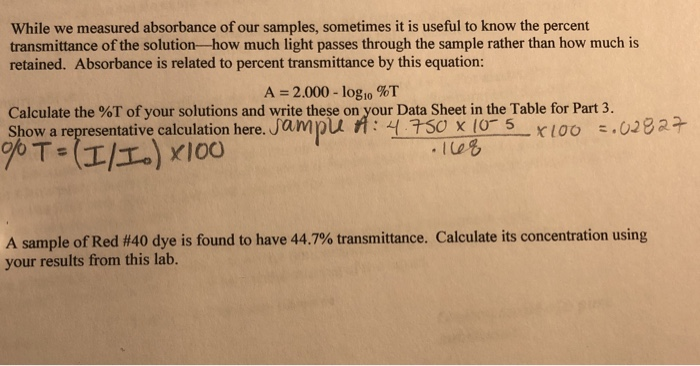
Transmittance calculation from absorbance. Obtaining an Absorbance Spectrum. It is the measure of the capacity of a substance to observe the radiation. The mass of the coloured compound in the same solution as in question 1 above that would have an absorbance of 15 in the same 100 cm cell is in grams.
If you know the absorption coefficient for a given wavelength and the thickness of the path length. An infrared spectrum is often viewed in absorbance with the peaks pointing up from the baseline instead of downward. 0075 log10 2 c.
Fluorescence and Absorbance Spectrometer Duetta is a spectrofluorometer that combines simultaneously the functions of fluorescence and absorbance spectrometers. 40 in commercial products we use a relationship called the Beer-Lambert Law or simply Beers Law. Calculation of concentration C AL x Ɛ In order to derive the concentration of a sample from its absorbance additional information is required.
Calculation Results for the Transmittance and Absorbance Data Transmittance Absorbance Intercepta Slope b Correlation coefficient 3. Transmittance T x 100 and Absorbance A To determine the concentration of FDC Red No. As one goes up the other goes down.
In particular in spectrophotometry of gases and liquids baselines are usually not a problem in relation to integration because the absorbance is employed not as defined i. Although your software will show higher absorbance values you should not trust to values higher than 2 absorbance units. The transmittance and therefore the absorbance are directly proportional to a samples concentration c molar absorptivity ε and cuvette pathlength l.
On a related note because transmittance has an inverse logarithmic relationship with absorbance this is why we cannot use transmittance in our calculations at least not. Many cuvettes have a light path of 10 mm 039 in which simplifies calculation of the coefficient of absorption. The linear T scale can be converted to absorbance where T is the percent transmittance expressed as a decimal eg 22 022.
A bc where A is absorbance unitless ε is the molar absorptivity. Transmittance When something is absorbed it means that that substance in this case light is essentially captured by an object and not able to escape. JIS R 3106 and JIS R 3106.
The relationship between transmittance and absorbance is logarithmic as described inEquation 2. Absorbance ranges from 0 to infinity. Having an incident intensity of I 0 and a transmitted intensity of I.
The smallest cuvettes can hold 70 microliters while the largest can hold 25 milliliters or more. Absorbance A then is defined as the logarithm base 10 of the reciprocal of the transmittance. We recommend to take in account absorbance values 0-1 or maximally 0-2.
Table view List view Keg E1 E2 E3 E4 E5 Average 5pts Expected Absorbance Calculation 44pts Follow the steps below using the average Keg value to determine the expected absorbance for test tube E3 a. Absorbance is the amout of light that is blocked by sample molecules. That is 100 transmittance is 0 absorbance units 10 transmittance is 1 absorbance units 1 transmittance is 2 absorbance units.
100 Absorbance 0 Transmittance While a spectrophotometer can display measurements as either transmittance or absorbance in biological applications we are usually interested in the absorbance of a given sample. Transmittance ranges from 0-100. If the data is collected in a transmission mode the y-axis should be in units of Transmittance T or absorbance abs.
But HOW are they related. Enter the calculation results in the following table Table 6. If the data is collected using a reflection technique ATR reflection.
A Log 10 T The most important lesson to take home from this logarithmic relationship is the realization that when the absorbance is 10 only 10 of the light beams full intensity. Transmittance and absorbance of light using Beers law. E as the negative decadic logarithm of the incoming and outgoing irradiance but as the negative decadic logarithm of the transmittance of the solution ratioed to the transmittance of the pure solvent43 This approach.
It is defined and expressed as the common logarithm of the ratio of incident to transmitted radiant power into a material. How do you calculate absorbance. Absorbance is a dimensionless unit which is also called as Decadic Absorbance.
About the spectrum on picture 1 you can tell following. What would you expect the intercept values to be for both T and Abs values for x0 ie. Absorbance and Extinction Coefficients The ratio of radiant power transmitted P by a sample to the radiant power incident P 0 on the sample is called the transmittance T.
Create an ICE table with the initial concentrations found for test tube E3 in the ICE table for E3. Thanks to its high-speed built-in CCD detector the Duetta can acquire a full spectrum from 250 nm to 1100 nm in less than one second making it the fastest fluorescence spectrometer on the market. Spectrophotometry Page 2 of 10 solution Transmittance or absorbed Absorbance by the solution is measured by a light meter.
According to Beers Law the absorbance is formulated as. If the left side -logII 0. T PP 0.
The Beer Lambert law defines the relationship between the concentration of a solution and the amount of light absorbed by the solution. Observe that absorbance is a pure number without units of measure. The relation between transmittance T and absorbance A is given by the Beer-Lambert law Beers law.
The absorbance values we have adhere very closely to those predicted by the Beers law which states that absorbance is directly related to the concentration of a sample. Taking the logarithm on both sides and transforming the formula-log II 0 εcl. A -log T log 1T.
Calculate or measure the percent transmittance of solutions at different concentrations using Beer Lambert law or Beers law calculator online. Absorbance is based on the ratio of two intensity measurements so the resulting value has no units. Transmittance is the amout of light that passes through the solution.
The transmittance and absorbance of light by a substance was first introduced followed by an explanation of the Beer-Lambert Law. Consider a solution and a monochromatic light is allowed to pass through it. The width determines the length of the light path through the sample which affects the calculation of the absorbance value.
The Lambert-Beer law which forms the physical basis for photometric applications describes that the absorption of light by a sample is directly proportional to its concentration and its path length. Absorbance and Transmittance are related. ISO 102921994 Glass in building Calculation of steady-state U values thermal transmittance of multiple glazing Other methods On special circumstances we can also perform test according to specific national standards eg.
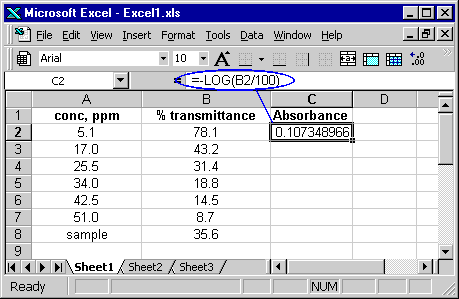
Chem301 Tutorial Calculations With Excel

Chapter 2 Quantitative Ppt Video Online Download
Solved Please Help Me Calculate The T Transmitance With Chegg Com
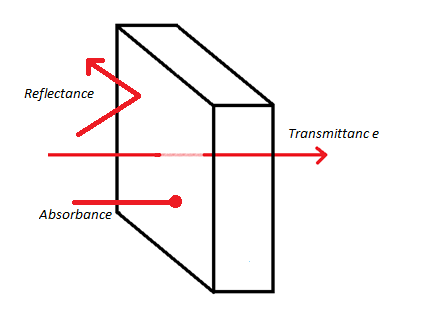
Radiation Absorbance Emissivity And Reflectivity Epsilon Engineer
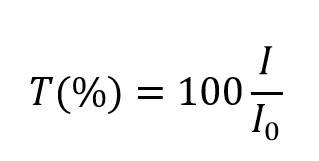
Beer Lambert Law Transmittance Absorbance Edinburgh Instruments

Transmittance Formula Transmittance To Absorbance Calculation Electrical4u
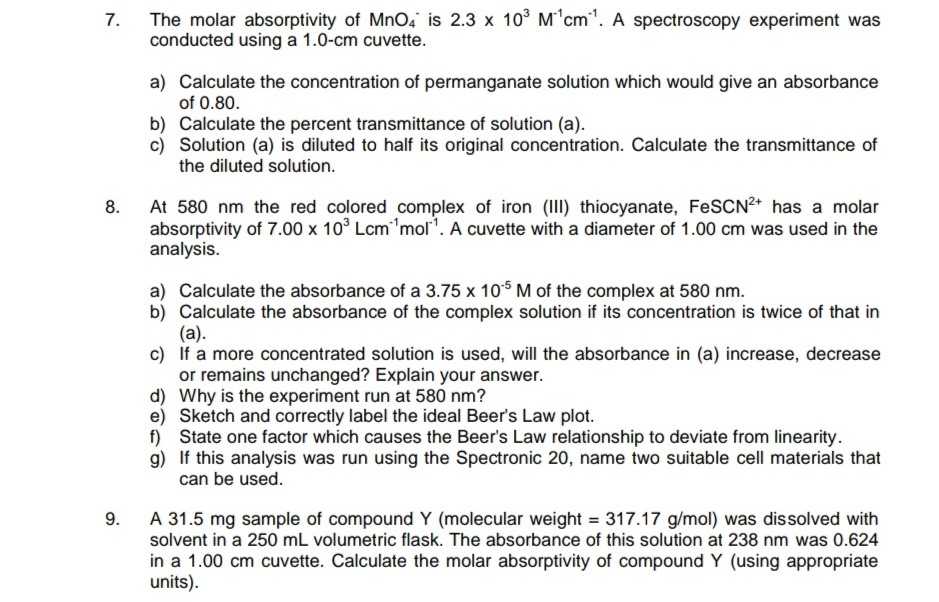
Solved 7 The Molar Absorptivity Of Mno4 Is 2 3 X 10m Cmi Chegg Com
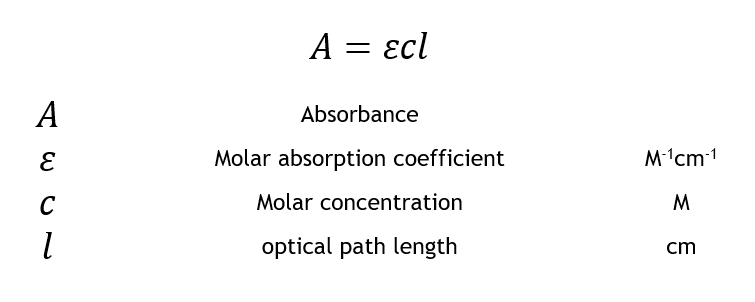
Beer Lambert Law Transmittance Absorbance Edinburgh Instruments


